Euchre - Card Game Offline
- 4.6
- Rating
- 1.00M
- Installs
- Free
- Price
 Analysis by App-foxy
Euchre - Card Game Offline is the kind of card game I reach for when I want a focused match without committing to a large, complicated game. Its appeal is straightforward: it puts Euchre at the center, keeps the presentation approachable, and is designed for play without an internet connection. After spending time with it, I found that its strongest quality is convenience rather than spectacle. It is easy to open, understand, and return to whenever I have a few quiet minutes.
That focus also makes the game easier to judge. This is not a broad collection of card games, and it is not trying to compete with a full social gaming platform. It is a dedicated Euchre experience from Topy Games, aimed at players who already enjoy the trick-taking format or want a compact way to practice it. The free entry point makes it simple to try, while the Everyone age rating keeps it suitable for a wide range of players.
How the game feels in everyday use
The first thing I noticed is how well an offline card game fits ordinary routines. I can imagine playing a few hands while waiting for an appointment, during a commute where connectivity is unreliable, or at home when I do not want notifications and online matchmaking competing for attention. The game’s central promise is not about constant novelty; it is about having Euchre ready when I want to play.
You May Also Like

 Blood Strike: 2.5 Anniversary
Blood Strike’s Loadouts Turn Every Drop Into a Tactical Gamble
A close look at Blood Strike’s custom loadouts: how fast access to signature weapons reshapes its battle royale rhythm, rewards preparation, and narrows the gap between fights.

 Pandora - Music & Podcasts
Pandora’s Music Is Easy to Start, but Harder to Recover
Pandora’s strength is its low-effort path from a seed to a station. Its weak spot is how much confidence it asks you to place in connection, setup, and quiet recovery.

 8 Ball Pool
 Is Built on Rivalries, Rematches, and Routine
A close look at the rivalries, rematches, shared routines, and unanswered safety questions that turn a quick pool match into a persistent mobile community.

 Samsung Music
’s Quiet Strength Is Playing What You Already Own
Its reach comes less from spectacle than from dependable access to a personal library. That simplicity is both the app’s strongest retention engine and its ceiling.

 AccuWeather: Weather Radar
AccuWeather Review: A Quick, Clear Forecast for Everyday Decisions
For everyday plans, the best forecast is the one you can understand quickly. AccuWeather makes rain timing, radar, and local conditions easy to act on, with a few trade-offs.

 Hill Climb Racing
Why Hill Climb Racing Still Turns Crashes Into One More Run
A tiny car, a bumpy hill and one more upgrade: Hill Climb Racing keeps resurfacing because its simple chaos makes every near-miss feel personal.
More From Our News Desk



That makes the experience feel more dependable than many online alternatives. I do not need to find opponents, wait for a lobby, or worry about a weak signal interrupting a hand. For me, that changes the rhythm of play. I can stop after a short session and come back later without feeling that I have abandoned a live match or inconvenienced another player.
The rules themselves create the depth. Euchre rewards careful attention to the trump suit, the strength of the hand, and the likely distribution of cards. A good move is not always the card with the highest immediate value. Sometimes I need to preserve a powerful card, draw out an opponent’s trump, or support the partner’s likely plan. That makes the game suitable for relaxed play, but it still gives experienced card players plenty to think about.
Why offline play matters more than it first appears
Offline access is not merely a backup feature here; it shapes the practical value of the game. When I play a traditional card game with people, the experience depends on having a table and willing opponents. When I use an online game, it depends on servers, connection quality, and the availability of other players. This title sits between those options by offering a solitary way to enjoy the rules whenever the timing is right.
That is especially useful for learning. A new player can take time to understand bidding decisions and trick order without feeling pressured by a human opponent. I would still recommend learning the basic rules separately if Euchre is completely unfamiliar, but the game can then serve as a low-pressure place to reinforce them. The ability to replay situations is more useful than simply reading a rules page because it connects decisions with consequences.
There is also a subtle benefit for experienced players: offline sessions make it easier to experiment. I can try a more aggressive call, lead a different suit, or change how I protect a strong card without worrying about losing ranking points or disappointing a teammate. That freedom is valuable for examining habits that feel automatic during normal games.
Speed expectations and the right kind of simplicity
In my experience, a focused card game should feel quick to enter and quick to understand. This one benefits from having a narrow purpose. It does not ask me to manage a large collection, learn several modes, or build a complicated account before I can concentrate on a hand. That limited scope helps the game feel responsive in the moments that matter: choosing a card, following the trick, and moving toward the next decision.
The perceived speed is also helped by the nature of Euchre itself. A hand has a clear structure, so I am rarely lost about what should happen next. The game’s pace comes less from flashy animation and more from removing unnecessary obstacles between decisions. That is a good fit for short sessions, although players who prefer dramatic effects or a highly animated table may find the presentation restrained.
One practical tip is to treat short sessions as a strength instead of trying to turn every break into a long campaign. I get more from the game when I focus on one or two specific skills, such as recognizing when a call is too ambitious or tracking which suits have already appeared. That approach makes a brief match feel purposeful rather than incomplete.
The game has a 4.7 average from around 44 thousand ratings, which suggests that its simple approach is connecting with a substantial audience. I do not take that as proof that every player will enjoy it, but it does match my impression that the clean, dedicated format is a major part of its appeal. People looking for a direct Euchre game are likely to appreciate that it does not bury the card play under unrelated systems.
What happens during heavier play
The busiest moments are not likely to come from complex graphics or a large game world. They come from repeated hands, quick decisions, and longer sessions in which I keep replaying a mistake because I want to understand it. That is where the game’s design matters most. A card game can remain demanding even when it is visually modest, because the mental workload comes from evaluating incomplete information.
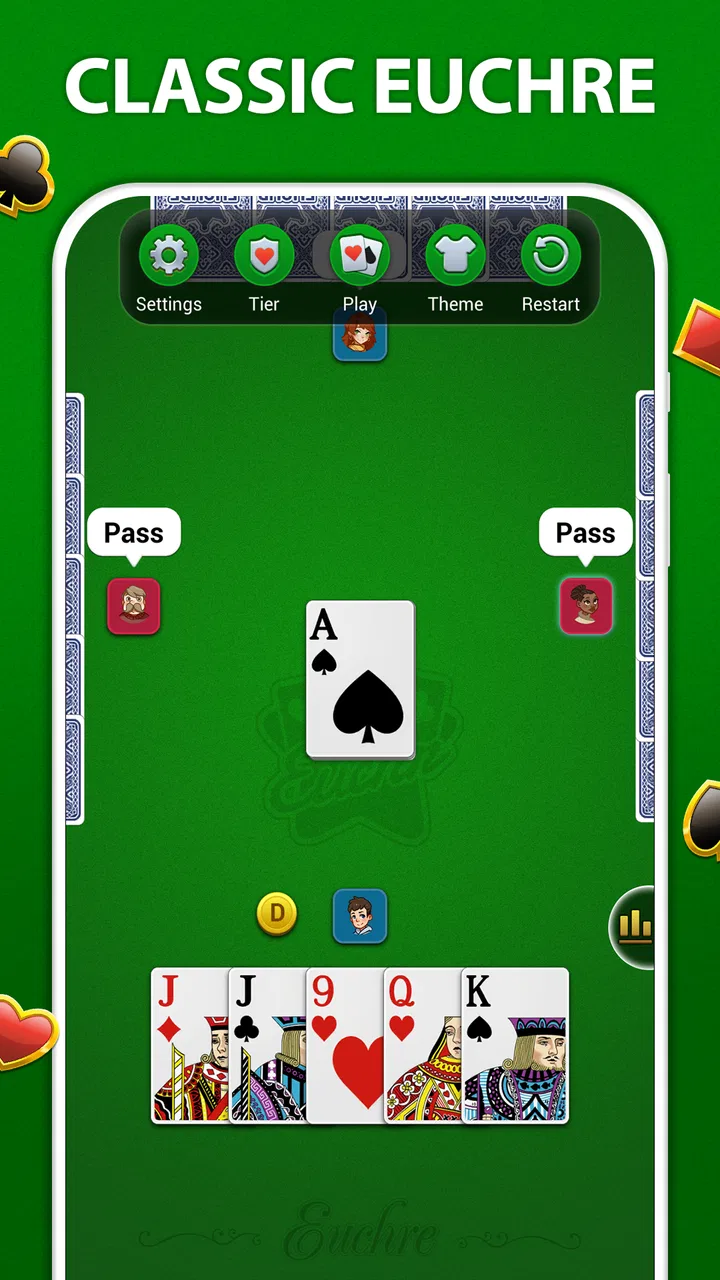
During a longer session, I pay more attention to how easily I can maintain a useful rhythm. If the interface presents the current hand clearly and keeps the action understandable, I can concentrate on strategy rather than searching for controls. The offline format also removes one common source of friction: connection interruptions during a decisive trick. That makes extended play feel more self-contained.
Still, the simplicity can become a limitation for players who need constant stimulation. Once I have played several hands, the core loop remains familiar. There is no reason to expect the variety of a large multiplayer card platform from a focused Euchre title. I would choose this game for repetition and practice, not for a constantly changing stream of events.
A useful way to avoid fatigue is to change the purpose of each session. I might concentrate first on bidding discipline, then on card counting, and later on reading the opponent’s likely strength from the way tricks develop. This is a more rewarding workflow than playing on autopilot. It also reveals whether I genuinely enjoy Euchre itself, rather than simply enjoying the novelty of a new app.
Stability, recovery, and interrupted sessions
Offline games have a practical advantage when life interrupts play. If I need to put the phone away suddenly, I am not leaving a live opponent waiting. That makes the experience more forgiving during everyday use. A game that can fit around interruptions is often more useful than one that offers more features but demands uninterrupted attention.
Recovery also matters when I return after a break. Euchre has enough structure that I can usually reorient myself by looking at the current hand and remembering the trump situation. The game does not require me to recall a large map, a long quest chain, or a complicated inventory. That makes it a good choice for casual players who may open it only occasionally.
I would not confuse offline access with unlimited protection from every possible interruption. The sensible habit is to finish a hand before closing the app when possible, particularly if I am using the game during a busy moment. Even in a compact card game, leaving at an awkward point can make the next session less satisfying. The important advantage is that the game is not dependent on a live connection for its basic purpose.
The title has reached over 500 thousand installs, and its current version is 1.3.8.20250703. Those details give me confidence that it is an established choice rather than an obscure experiment, while the version information is useful for checking compatibility before installing. The developer, Topy Games, has kept the product centered on its main card-game identity instead of turning it into a general entertainment hub.
Device constraints and resource expectations
The minimum requirement is Android 6.0, so the game is accessible to people using older Android devices as well as newer phones. That broad compatibility suits the app’s purpose. A Euchre game does not need the newest hardware to make its central decisions enjoyable, and players who keep an older phone as a backup can still consider it a practical option.
From a resource perspective, the game’s card-focused design should be less demanding than a modern action game or a visually intensive strategy title. I would choose it for an older or modest device when I want something useful without turning the phone into a dedicated gaming machine. That said, general device condition still matters. An older phone with limited free storage, an aging battery, or many background tasks may feel slower with any app, so expectations should remain realistic.
One of the better use cases is a secondary device. I can see this working well on a tablet kept in a living room, an older phone used during travel, or a device reserved for quiet offline activities. Because the game’s value comes from the card decisions rather than advanced visual effects, it does not need to be the newest device in the household to remain worthwhile.
The free price is another reason to test it rather than speculate. There are in-app purchases priced at $14.99 per item, so I would pay attention to the purchase screen and decide in advance whether I want only the free experience or whether an optional purchase is worthwhile for me. The important point is that the initial download does not require an upfront payment, but “free” does not mean every possible item or upgrade is necessarily included.
How it compares with other ways to play Euchre
Compared with a physical deck, the app removes setup, shuffling, and the need to find people at the same table. That is its clearest advantage. A real deck is better when I want conversation, visible social interaction, and complete control over the pace. The app is better when I am alone, short on time, or away from a table.
Compared with online Euchre games, the offline format trades social competition for consistency. Online play can offer human unpredictability and a stronger sense of occasion, but it can also bring waiting, connection problems, and pressure to remain available. This game is the better choice when I want to practice or relax without those conditions. It is the weaker choice if my main goal is meeting opponents, chatting, or proving myself against a live community.
Compared with a broad card-game collection, the dedicated format is easier to approach. I do not have to move between unrelated rules or learn a different interface every time I open the app. The trade-off is obvious: anyone seeking solitaire, poker, bridge, or a rotating selection of games will need a different download. This is a specialist tool for Euchre, not a universal card table.
That distinction helps answer an important question: who should skip it? I would look elsewhere if I dislike trick-taking games, need multiplayer interaction, or expect a steady supply of new modes. I would also skip it if I want a richly animated presentation or a social platform built around friends and competition. The game’s narrow focus is a benefit only when that focus matches what I want.
Practical ways to get more from each hand
My first recommendation is to slow down before calling trump. In Euchre, an attractive hand can still be awkward if it lacks support or if the strongest card depends too heavily on one narrow plan. I try to ask what happens if the first trick does not go my way. That simple question helps separate a hand that looks exciting from one that is actually manageable.
Second, I use offline play as a laboratory for memory. Instead of only chasing wins, I keep track of which suits have disappeared and which cards are likely to remain. This turns the game into a small mental exercise. It is one of the less obvious strengths of the format: because there is no live opponent waiting for me, I can deliberately pause and reconstruct the hand.
Third, I avoid judging the partner or opponent too quickly. A single lost trick does not always mean the decision was poor. Sometimes the correct play produces an unfavorable result because the unseen cards fall the wrong way. Replaying with that distinction in mind helps me improve strategy rather than merely reacting to outcomes.
Finally, I recommend using the game as a routine rather than an all-day distraction. A few intentional hands can sharpen pattern recognition and provide a calm break. If I continue playing only because I am chasing a better result, the focused design can start to feel repetitive. Knowing when to stop is part of getting value from a simple game.
Who will enjoy it most
This is a strong match for players who already know Euchre and want a convenient solo option. It also suits newcomers who prefer learning privately, provided they are willing to spend time understanding the rules and the logic behind bidding. People with older Android phones may appreciate the Android 6.0 minimum, while travelers and commuters can benefit from not building their plans around an internet connection.
Families may also find the Everyone rating reassuring when choosing a straightforward card game for a shared device. The experience is calm and familiar rather than built around mature themes or intense action. I would still explain the rules to younger players, because the age rating does not remove the learning curve created by trump selection and trick-taking strategy.
Players who want a quick mental reset are another natural audience. The game gives me a clear task, a limited decision space, and a natural stopping point after a hand. That combination is more satisfying than endlessly scrolling when I have a few spare minutes, especially when I want something interactive but not demanding in a visual or technical sense.
My performance verdict
After considering speed, heavier sessions, stability, and device flexibility, I see this as a deliberately practical card game. Its performance appeal comes from restraint: the experience is centered on Euchre, works offline, and does not require the kind of hardware associated with visually ambitious games. That does not make it exciting for everyone, but it makes it easy to fit into real life.
The limitations are equally clear. The focused design may feel repetitive to players who need variety, and the offline approach cannot replace the unpredictability or social energy of live opponents. The presence of in-app purchases also means I would review any optional purchase carefully instead of assuming the free download tells the whole story. These are not deal-breakers for me, but they define the audience.
Overall, I recommend it to anyone who wants a dedicated offline Euchre game for practice, short breaks, travel, or relaxed solo play. Topy Games has chosen a narrow lane, and that is exactly why the title works when the lane is yours. If you want a dependable card table that is ready when you are, this is an easy free game to try. If you want conversation, live competition, or a large collection of card formats, another option will serve you better.
My final take: this is a useful, accessible Euchre companion rather than a complete social gaming destination. I value it most for the way it removes waiting and connection concerns while leaving the strategic decisions intact. For the right player, that balance is enough to make it a regular part of a casual game library.
FAQs for Euchre - Card Game Offline
01What features does Euchre - Card Game Offline offer?
Euchre - Card Game Offline provides a classic card game experience without the need for an internet connection. It includes customizable rules, various difficulty levels, and AI opponents to challenge your skills. The app also offers a user-friendly interface, detailed statistics, and an option to play with friends locally.
02Is Euchre - Card Game Offline suitable for beginners?
Yes, Euchre - Card Game Offline is designed to cater to all skill levels, including beginners. It features a comprehensive tutorial mode that guides new players through the rules and strategies of the game. The adjustable difficulty settings also allow users to start easy and gradually increase the challenge as they improve.
03Does Euchre - Card Game Offline require an internet connection?
No, Euchre - Card Game Offline is designed to be played without an internet connection. This makes it ideal for users who want to enjoy the game while traveling or in areas with limited connectivity. However, some features, like updates or in-app purchases, may require internet access.
04Can I customize the game settings in Euchre - Card Game Offline?
Yes, the app allows for a high level of customization. Players can adjust the rules to match their preferred version of Euchre, select different card decks, and change the background themes. This flexibility ensures a personalized gaming experience tailored to individual preferences.
05Is there a multiplayer option in Euchre - Card Game Offline?
While the game primarily focuses on offline play, it does offer a local multiplayer option. Players can connect with friends via Bluetooth or Wi-Fi to enjoy a shared gaming session. However, for online multiplayer functionality, an internet connection and additional features may be required.
Pros
- Smooth offline gameplay experience.
- User-friendly interface with easy navigation.
- Variety of difficulty levels available.
- Customizable card decks and tables.
- No internet connection needed to play.
Cons
- Limited multiplayer functionality.
- Ads can be intrusive at times.
- No tutorial for complete beginners.
- Lacks advanced strategies and tips.
- Limited customization options for avatars.

Euchre - Card Game Offline
Gallery